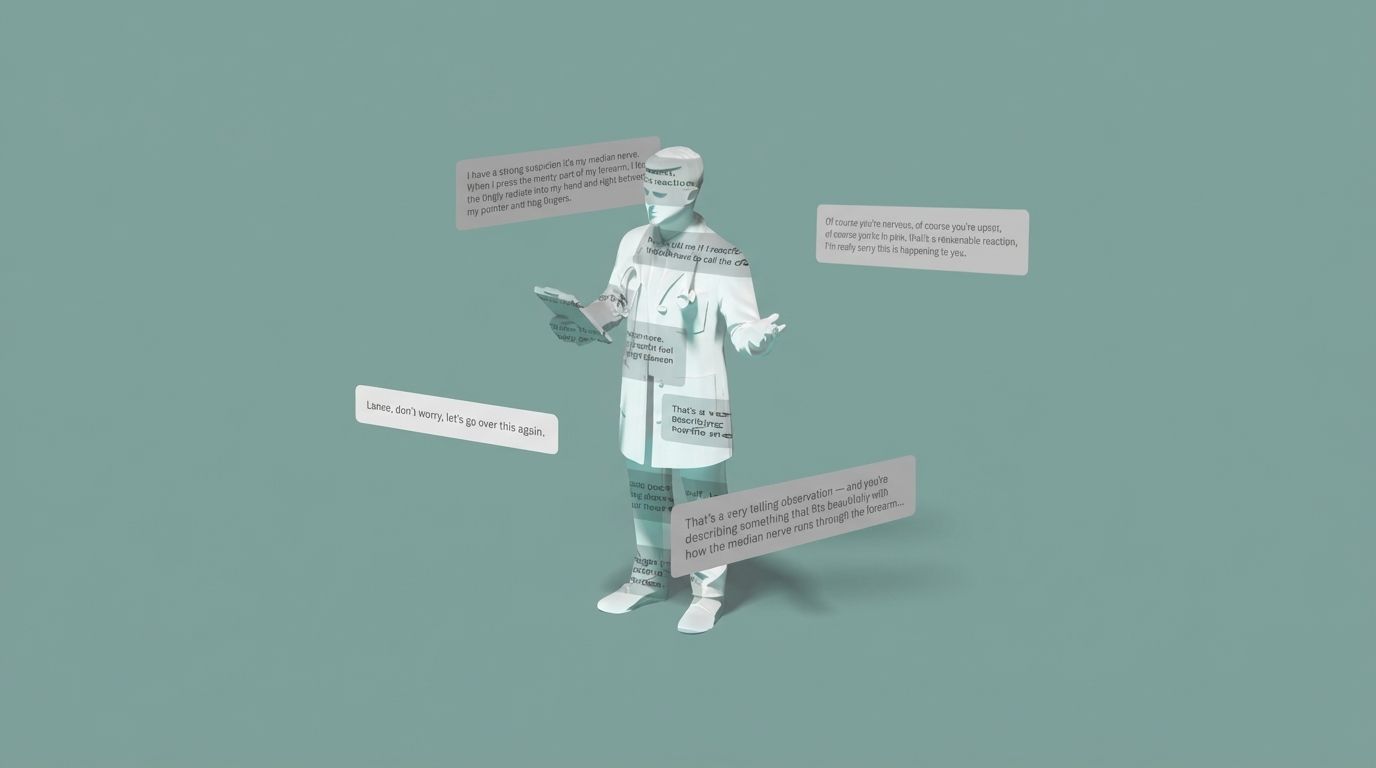
Health is what happens between appointments. Now health systems need to be there too.
Dan Kraemer
Co-Founder & Co-CEO
Health is continuous. A patient manages her family's care between appointments, at 10pm, in the minutes before she falls asleep wondering if the referral went through. A patient nine months out from treatment for a rare cancer monitors herself — sleep patterns, energy levels, things she notices but isn't sure are worth mentioning.
Health systems have always been something different: episodic. Present at the appointment. Available at the portal. Responsive to the call. The model has never matched the reality of how patients actually live with their health.
AI doesn't just improve how health systems operate, it closes the gap – between when patients need their system and when their system is present. That's a more fundamental shift than most digital health strategy currently reflects — and the health systems that build for it now will own patient relationships that no competitor can replicate.
There are three specific places where that gap closes. Three moments where continuous presence becomes possible for the first time. Three levers that together define what it means to be a health system that's genuinely with patients, not just available to them.
Lever 01: AI-Enabled Discovery & Access
Growth driver: New patient acquisition
Your next patient’s referring physician is a chatbot.
Maya needed a perimenopause specialist. Her primary care doctor pointed her in a direction and left her to navigate. She didn't Google it. Her husband had built a custom ChatGPT that she used to ask questions, find recommendations, identify providers. She chose the one she liked best that was a drivable distance from her.
Avery had a rarer problem. She'd just been referred across the country for adenoid cystic carcinoma — fewer than 1,200 cases diagnosed in the US each year. Her oncologist said: go somewhere that sees a lot of these. She opened ChatGPT and asked which specialist she should request, and whether she could actually get in.
In both cases, the decision was made with a bot. Where to go — which health system, which specialist, which program — was made in an AI conversation before either patient ever contacted the health system directly. By the time they clicked through, the choice was already forming.
This is the new front door. And it looks nothing like a portal.
The health systems that show up well in this moment have done something specific: They've made their clinical programs, provider credentials, and subspecialty differentiation readable by machines — not just humans. Structured schema on provider profiles. An API that returns specialist data when an LLM queries it. A real-time signal that says: accepting new patients, first available window early April. This is what makes the difference between being the answer and being mentioned in passing.
The competitor hospitals show up too, but as text. You show up as a solution.
And when the patient clicks through, the page she lands on already knows why she's there. Not a blank intake form. A smart handoff — diagnosis, referral source, and destination carried from the AI conversation into your system. No cold start. No re-explaining.
What it takes: structured content that LLMs can cite, a provider data endpoint, an availability signal, and a parameterized intake URL. For most health systems, the infrastructure exists. The connection doesn't yet.
ROI: New patient acquisition. The patient was already looking. The question is whether your system was findable in a way that converted.
Lever 02: Predictive Orchestration
Growth drivers: Digital-to-scheduled conversion, NPS
Patients remember the appointment they didn’t have to make.
Maya manages her family's healthcare the way a good project manager runs a complex workstream. She signs paperwork at first appointments so she can access records later. She sets up her own notification systems. She does the calendar nudges. She told us directly: "If I was not around, there would be a lot of things missed."
She's not unusual. She's the norm. Patients have always carried the coordination burden because health systems couldn't. AI changes that equation.
Avery's version of the same gap is higher stakes. Nine months post-treatment for a rare salivary gland tumor, her clinical protocol calls for a head-and-neck MRI, a lab draw, and an oncology visit — timed precisely to the window when recurrence is most detectable. Missing that window isn't an inconvenience. It's a clinical risk.
The second lever is the system carrying what the patient used to carry.
For Avery, this looks like three appointments bundled into a two-day visit — MRI, lab draw, oncology — proposed proactively, confirmed in a single interaction, travel window identified automatically. The clinical intelligence was already in the protocol. The system just needed to act on it rather than wait for her to ask.
For Maya's family, it’s a notification three weeks before a colonoscopy is due: "We've held a time. Tuesday March 18, 9:30am. Confirm?" One tap. Done. The system knew. The system acted. Maya didn't have to be the middleware.
What it takes: a protocol engine that knows when to trigger based on diagnosis and care history, a scheduling API that bundles across departments into coordinated windows, and a push channel with one-tap write-back into the EHR. Most health systems have the underlying infrastructure. The investment is in the layer that connects it to proactive action.
ROI: Digital-to-scheduled conversion — patients due for care who confirmed without a phone call or staff touch. NPS — because this is what patients mean when they say their health system takes care of them.
Lever 03: Enterprise Intelligence
Growth drivers: Retention, reduced referral leakage
Loyalty isn’t earned at the appointment. It’s earned between them.
Avery's care team had been reviewing her data from the week. Sleep averaging 5.2 hours. HRV trending below baseline for four consecutive nights. Activity at 72% of goal. Nothing alarming on its own. Then she mentioned, almost in passing, that she'd noticed some tingling on the left side of her face.
In the context of her diagnosis, that symptom is a flag. Perineural spread — the way adenoid cystic carcinoma typically recurs — presents exactly like that. The data and the symptom together meant something that neither meant alone.
The third lever is the system watching across the full data picture — continuously — so that the signal doesn't have to wait for the patient to report it.
For Maya's mother, continuous intelligence means a discharge trigger that fires a coordinated referral workflow automatically. The system knows she’s managing leukemia through a complex care episode, so nobody hands her a list of names and says good luck. The system connects the discharge event to the next clinical action without a gap.
For Avery, it means a remote monitoring program that sits between visits — collecting, watching, and acting. A wearable data pipeline connected to her clinical record. An NLP layer that reads her messages for signals her care team needs to know about. A facial symmetry assessment she completes in 30 seconds on her phone, compared against her own baseline, capable of detecting the kind of subtle asymmetry that would otherwise require a clinic visit to evaluate.
The data is already there. The watching is what's new.
ROI: Retention and reduced referral leakage. Patients who stay connected stay. Patients who fall through gaps don't come back.
The investment is in connection, not construction.
The argument we hear most often against this kind of thinking is infrastructure: we don't have the data architecture, the EHR doesn't support it, we'd need to rebuild from scratch.
In our experience, that framing reverses the actual challenge. Most health systems have an Epic implementation with FHIR APIs exposed, a data warehouse, a patient app, provider directories, and clinical protocols with meaningful subspecialty differentiation. They have the data. They have the platforms. Health systems often have more infrastructure than they’re actively using.
What hasn't been built is the connection between that infrastructure and the moments that matter — the 10pm question, the due appointment, the symptom mentioned in passing. That is a design and integration problem, not a construction problem. It responds to a different kind of approach.
Start from the patient. Work back to the build.
Everything we've described starts from a specific human moment — not a technology capability. A woman at her kitchen table with a referral letter and a question she doesn't know how to answer. A family that needed someone to carry the coordination. A patient nine months out from treatment who mentioned something in passing that shouldn't be ignored.
We've found that the most important thing a health system can do before committing to an architecture is to watch a real patient try to navigate their care. Not survey them. Watch them. The insight doesn't come from the data. It comes from the moment the data doesn't capture — the question asked at 10pm, the symptom mentioned in passing, the appointment that almost didn't get scheduled.
Build from there. Design what the experience needs to be. Then ask what the technology needs to deliver.
Thats the sequence that turns infrastructure into continuous presence. And continuous presence is what turns a health system into something patients don't leave.
IA Collaborative works with health systems and enterprise organizations at the intersection of behavioral insight, AI strategy, and consumer experience design. We prototype the future before our clients invest in building it.
Global Navigation
# IA Collaborative
> Navigation Map